
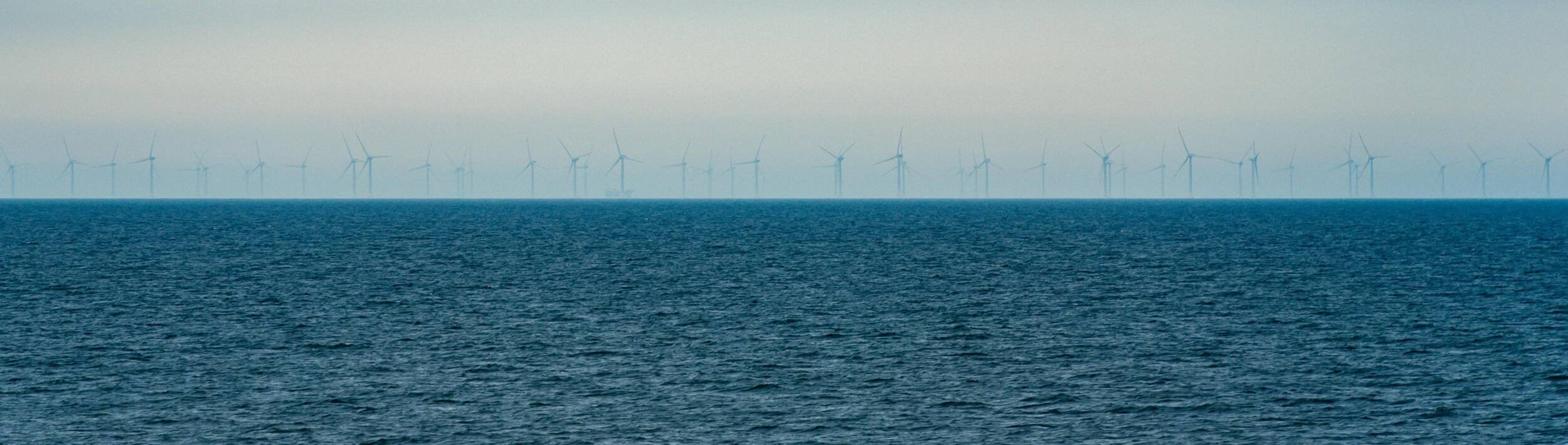
By Lilly Price – 3/5/2026
Understanding the War on Wind Energy
Wind energy has been in the news frequently over the past year. Offshore projects have been halted by executive order. Onshore projects are finding political resistance even in longstanding wind-friendly communities. Tax credits that structured the industry’s finances for decades are being phased out under the One Big Beautiful Bill Act. And yet, installed wind power capacity is still growing, electricity demand is rising faster than at any point in decades, and the economics of wind at the turbine level remain competitive.
These contradictions have left many wondering how opposition to wind energy works, how much a federal administration can change the trajectory of an industry that has its deepest roots in Republican-leaning states, and whether wind power is stalling out. It isn’t. But it is being made more fragile through mechanisms that are mostly less visible than outright prohibitions.
Where Wind Stands Right Now
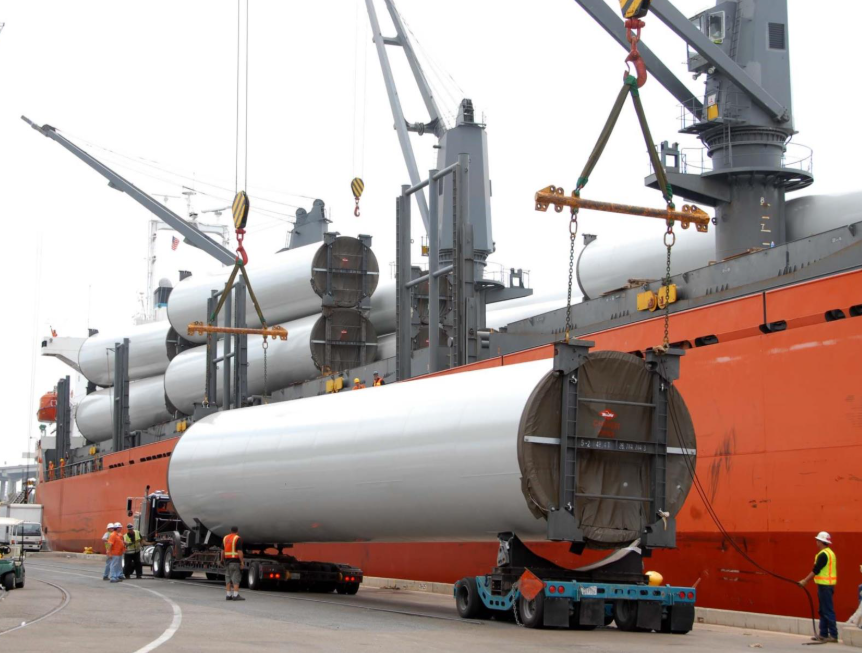
Offshore turbine pile components being shipped from a port in California [Source: https://www.flickr.com/photos/8123170@N06/3707640583]
Wind energy generated approximately 10.5% of total U.S. electricity in 2025, making it our largest single source of renewable electricity. U.S. wind installations in 2025 were up 36% from 2024. These are not stalling numbers. They do, however, represent the final years of a particular policy and financing regime.
Wind is a capital-intensive technology whose revenue streams must be contracted or hedged across a 20-to-30-year operating life before financing can close. That means lenders and equity investors are not just evaluating today’s policy environment; they are making a bet on the regulatory environment across multiple future administrations. When that environment becomes unpredictable, the cost of capital rises and projects can become less viable. The administration’s specific tools, such as tax credit phaseouts, permitting slowdowns, and executive orders all work primarily by exploiting this structural vulnerability.
Globally, wind additions in 2026 are expected to decline roughly 6% from the prior year, partly due to the end of China’s 14th 5-year development cycle in 2025, but also because U.S. policy headwinds are beginning to curb the broader buildout. A president cannot kill the wind industry, but the current administration is doing meaningful damage to wind’s near- and medium-term growth trajectory.
The Federal Toolkit: Tax Policy, Permitting, and Manufactured Uncertainty
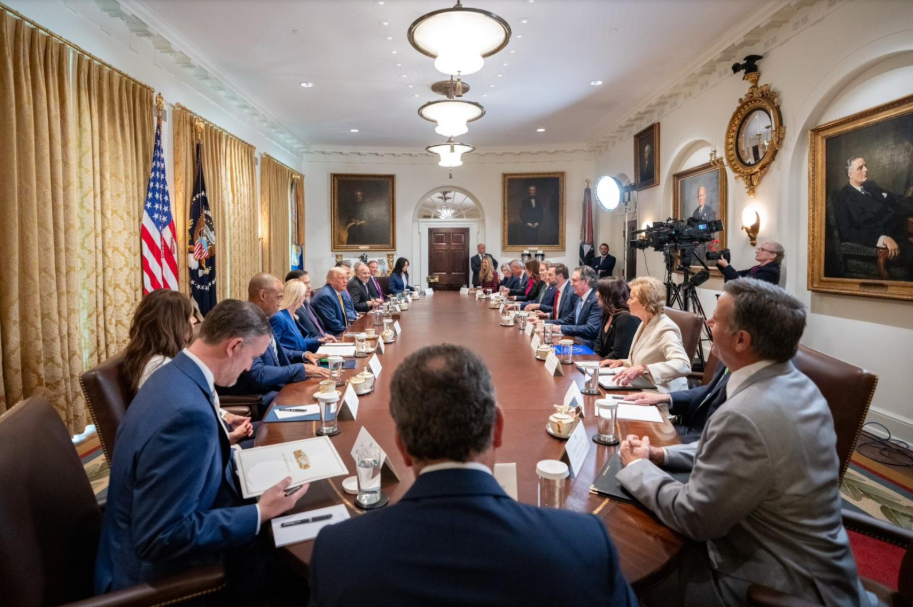
A presidential cabinet meeting following passage of the One Big Beautiful Bill [Source: https://x.com/VP/status/1942679722304962745 ]
The tax credit phaseout
The production tax credit for wind, which structured project financing for three decades, is now being phased out under the One Big Beautiful Bill Act passed by Congress in the summer of 2025. Under the prior structure, developers could assign the future stream of tax credits to investors in exchange for upfront capital, making it possible to finance projects that would otherwise be too capital-intensive to build. Now, projects that begin construction before July 4, 2026 retain eligibility under existing rules, with four years to reach operation. Projects that miss that deadline must either reach commercial operation by the end of 2027 or miss out on this key financial incentive.
That new deadline is compressing the development pipeline in ways not yet visible in current installation figures. Energy analysts now expect no new offshore wind farms will be built in the United States after 2028; the construction timelines are simply too long to comply with deadlines, and international investors must attach a premium associated with the increased risks that makes those projects unfinanceable. Onshore wind is less exposed: the technology is more mature, project costs are lower, and timelines are shorter. But the loss of tax credits still changes the math for marginal onshore projects, particularly those in areas with lower wind resource quality or higher transmission costs.
The phaseout passed with Republican votes, but a bloc of representatives from wind-producing states were conflicted. Rural counties in Texas, Iowa, and Oklahoma collect substantial property tax revenue from wind farms, and landowners earn lease payments that are often more reliable than agricultural commodity prices. That bloc is unlikely to push for restoration of the credits, but it represents a ceiling on how much further Congress is likely to go in actively penalizing wind development.
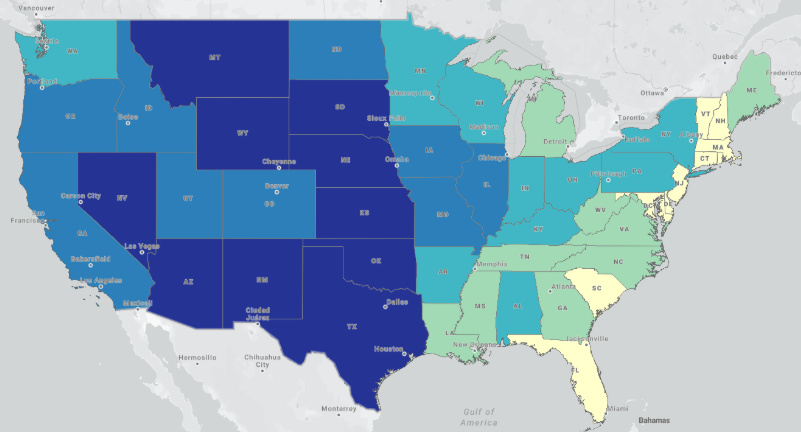
Wind power generation by state, with Texas in the lead followed by Montana [Source: https://maps.nrel.gov/slope/data-viewer?filters=%5B%5D&layer=energy-generation.land-based-wind&year=2020&res=state]
Executive orders and their limits
Federal leverage applies unevenly between offshore and onshore wind. Outer Continental Shelf development for offshore wind requires federal leasing, environmental review, and ongoing agency oversight, giving the administration multiple points of direct intervention, including via executive order.
On January 20, 2025, President Trump signed an executive order withdrawing all federal offshore areas from new wind leasing and directing review of existing leasing and permitting practices. One developer alleged losses exceeding $1.25 million per day due to a stop-work order. A federal court later called the order “arbitrary,” finding it violated federal law. In February 2026, a federal court allowed Revolution Wind to restart construction. The 800 MW Vineyard Wind 1 and 715 MW Revolution Wind projects, which will collectively power 750,000 homes, remain in active development despite ongoing litigation. But court victories do not fully repair investor confidence. Projects that entered the pipeline under one policy regime take years to emerge from it, which means the full effect of today’s cost and policy environment will not be legible in installation figures for some time.
Permitting as the most durable tool
The most consequential and legally durable mechanism for wind project opposition has been permitting process changes. Interior Secretary Doug Burgum issued a memo requiring that a wide range of federal decisions on wind and solar projects, including routine consultations with the Fish and Wildlife Service and Army Corps of Engineers, be subject to review by his office directly. One major solar developer described the practical effect of the requirement: “Historically this was a check-the-box process. Now that everything has to go up to the secretary’s desk, it’s essentially a pause on permitting.” More than 60 major wind and solar farms under development on federal lands are currently stymied, and hundreds of projects on private land requiring federal consultations are also paused.
From a legal standpoint, this is harder to challenge than a formal moratorium because it exploits genuine administrative discretion over review timelines. Developers are not being told no; they are being told to wait indefinitely. Establishing that a delay constitutes a denial requires showing that the delay is not a reasonable exercise of administrative judgment, which is a high bar. And delays are uniquely damaging to wind finance due to the capital requirements and sensitivity of investors described above.
This dynamic has not gone unnoticed beyond the wind sector. Jason Grumet, CEO of the American Clean Power Association, has noted that his members are now seeing a “risk premium associated with investing in the United States.” Exxon Mobil CEO Darren Woods told the New York Times that unpredictable policy “is not good for business. It’s not good for the economy and ultimately, it’s not good for people.” Some oil and gas executives have privately noted that the same sometimes-illegal tools being deployed against offshore wind could be turned by a future administration against gas pipelines. The U.S. Chamber of Commerce raised this concern formally, warning that the administration’s actions risk raising electricity costs and undermining the country’s ability to meet growing demand.
The Grid is the Choke Point
Even before the current administration’s permitting interventions, transmission was the primary choke point for wind deployment, and it remains largely beyond any single administration’s grasp. As of the end of 2025, approximately 2,300 GW of proposed generation and storage capacity is waiting in interconnection queues across the United States, more than twice the country’s current installed generating capacity. The average wait time in the queue is 4.5 years, and the majority of the queue is comprised of renewable sources. Only about 19% of queued projects reach operation; the rest are withdrawn, often after years of costly studies. Projects die in queues not because turbine components are unavailable, but because studies, upgrades, and cost allocations take years to resolve in this system.
The problem is structural and very sticky. Transmission lines cross property boundaries, jurisdiction boundaries, and regional grid boundaries. The landowner whose property sits in the path of a proposed line has more legal standing to block it than any of the millions of electricity consumers who would stand to benefit from it. Local governments often cannot capture the regional benefits of transmission to make the case to their constituents; the costs are local and immediate while the benefits are regional and probabilistic. Transmission lines are typically permitted at the state level, where governors and public utility commissions often face strong local resistance that doesn’t neatly map onto political boundaries.
The consequences of slow interconnection are already showing in consumer electricity costs. PJM, which serves 65 million people, saw its annual capacity auction cost balloon from $2.2 billion to $14.7 billion in a single year, partly as a consequence of slow interconnection of new resources. Consumers bear those costs directly through higher electricity rates.
Federal permitting reform could streamline some of these processes. But getting wind energy from where the wind blows to where people live requires planning-level decisions about cost allocation, eminent domain, and interstate coordination that are politically difficult and that no single administration can resolve on its own. The structural difficulty of those decisions has also made transmission a target for organized opposition.
Understanding Opposition to Wind
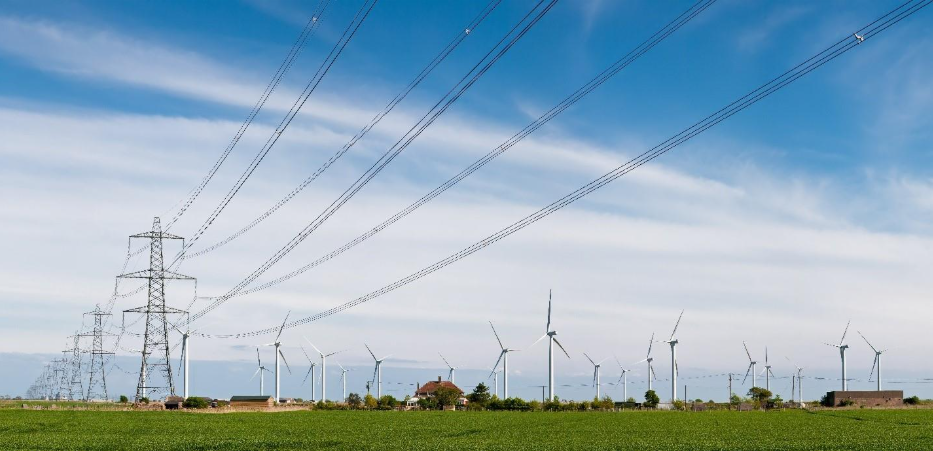
Wind farm with above-ground transmission lines [Source: https://commons.wikimedia.org/wiki/User:Diliff ]
Opposition to wind energy comes in a few distinct varieties that are worth separating because they reinforce each other in ways that are hard to disentangle in public debate.
The most straightforward is genuine local concern. Wind turbines are large, visible, and loud relative to the rural landscapes they occupy. Property value concerns are frequently cited in political advocacy, and have some empirical basis in specific locations. Noise and shadow flicker affect a small number of adjacent residences. These concerns are the ordinary politics of land use disputes that surround many types of infrastructure development.
Layered on top of that is organized opposition fostered by fossil fuel interests and their affiliated advocacy networks, through funding of local groups, coordination of public comment campaigns, political donations, and the deliberate nationalization of what would otherwise be local zoning disputes. Inside Climate News documented in January 2026 how onshore wind development has nearly stalled in historically wind-friendly Iowa, with opposition campaigns drawing on outside legal strategies and organizing resources far beyond what local communities could sustain on their own.
Then there is cultural opposition driven by the partisan sorting of environmental issues. Wind energy is being coded as a “progressive” cause in ways that make it politically costly for Republican elected officials to defend even when their constituents benefit directly. The framing of wind as a “coastal elite” technology does not represent the economic reality of rural communities, but it may increasingly represent their beliefs. In many of these rural landscapes, wind development has been among the most significant sources of new revenue in decades by generating substantial property tax revenue for schools and roads and offering landowners lease payments that are often more reliable than crop prices.
Finally, there are legitimate environmental tradeoffs. Bird and bat mortality at wind turbines is a real ecological concern. The Fish and Wildlife Service has historically worked with developers on mitigation measures, including shutting turbines down during high migration periods. The current administration has signaled it will step up enforcement against wind farms that kill eagles while simultaneously making it harder to obtain the permits that provide legal protection for incidental kills, a situation some developers describe as a deliberate legal trap. Wind turbines kill far fewer birds per unit of energy produced than fossil fuel combustion, and that relative scale is what good faith attempts to protect wildlife will reference. There is also research showing that construction of offshore wind farms creates noise that can temporarily displace marine mammals, but claims about large-scale whale deaths and strandings are unsubstantiated.
The Stakes
If you pay an electricity bill, wind energy policy affects how much you pay and what proportion of your bill is used to prop up outdated fossil fuel generators. The stakes are both financial and environmental. Every policy decision that delays a wind project, stalls a transmission line, or raises the financing cost of clean energy locks in an alternative. For now, that alternative is often fossil fuel.
Choosing to buy renewable energy is one way of participating in these decisions by voting with your dollars. As a member-owned cooperative, The Energy Co-op is making the choice alongside you that investing in renewable energy growth is well worth it.